In pharmaceutical testing, food safety, and environmental analysis, quantifying volatile organic compounds (VOCs) within non-volatile or complex solid and liquid matrices is a persistent challenge. Direct liquid injection of syrups, polymers, biological fluids, or heavy oils fouls chromatography columns and contaminates inlet liners. Headspace Gas Chromatography (GC-HS) solves this by analyzing only the gas phase above the sample, ensuring clean, high-precision quantification without tedious extraction steps.
Whether you are testing for residual solvents according to USP <467>, evaluating aroma profiles in consumer foods, or monitoring VOCs in wastewater, GC-HS is an indispensable workhorse in modern quality control and R&D laboratories.
What is Headspace Gas Chromatography?
Headspace Gas Chromatography (GC-HS) is a sample-preparation and introduction technique coupled with gas chromatography. Instead of injecting the raw liquid or solid matrix into the chromatograph, the sample is sealed inside an airtight vial and brought to thermodynamic equilibrium at a controlled temperature.
Once volatile compounds partition from the sample matrix into the overhead gas volume (the “headspace”), an aliquot of this clean vapor phase is sampled and transferred directly into the GC column for separation and detection.
The Partition Coefficient ($K$) and Phase Ratio ($\beta$)
The sensitivity and efficiency of headspace extraction depend on thermodynamic equilibrium between the sample phase and the vapor phase, governed by two fundamental parameters:
- Partition Coefficient ($K$): The equilibrium distribution of analyte between the liquid/sample phase ($C_s$) and the gas/headspace phase ($C_g$):
K = Cₛ / C_g- A lower K value means more of the volatile compound enters the gas phase, increasing chromatographic sensitivity.
- Modifying vial temperature, adding salts (“salting-out” effect), or adjusting matrix pH can lower $K$.
- Phase Ratio ($\beta$): The ratio of the headspace gas volume ($V_g$) to the sample volume ($V_s$):
β = V_g / Vₛ - Total Concentration in Headspace ($C_g$): Combining these parameters gives:
C_g = C₀ / (K + β)Where $C₀$ is the initial concentration in the sample. For volatile compounds with very low $K$, reducing $\beta$ (increasing sample volume) maximizes the mass of analyte transferred onto the GC column.
Core Instrumentation & Sampling Techniques
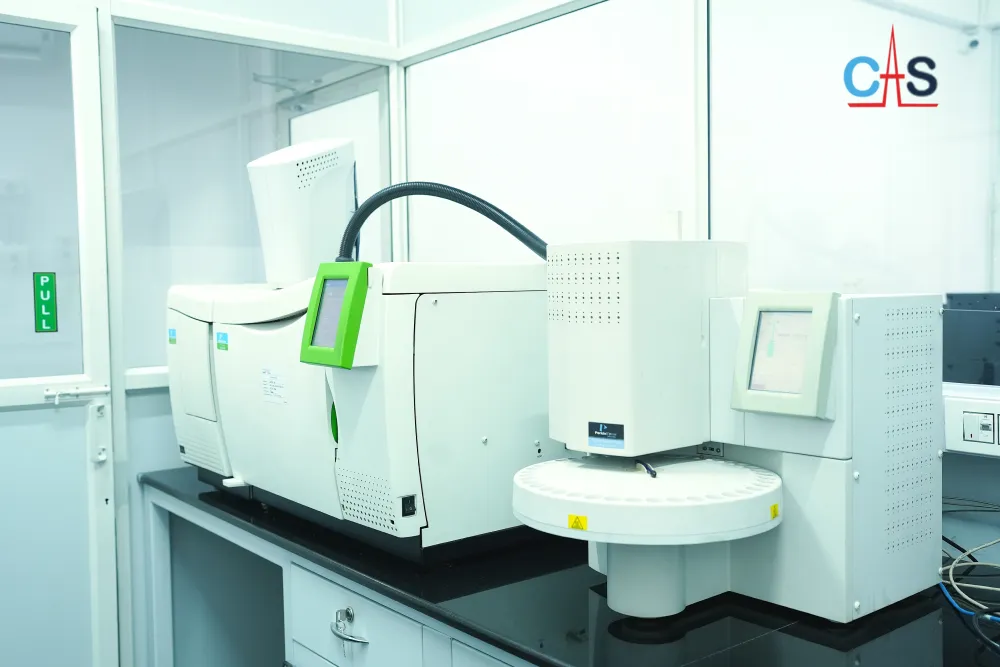
A typical GC-HS configuration integrates an automated headspace sampler with a standard Gas Chromatograph (equipped with an FID, TCD, or Mass Spectrometer).
[ Sealed Sample Vial ] ➔ [ Thermostatted Incubation Oven ] ➔ [ Gas-Phase Sampling (Loop / Trap) ] ➔ [ Heated Transfer Line ] ➔ [ GC Inlet & Capillary Column ]
Headspace sampling relies primarily on three technical approaches:
1. Static Headspace (Equilibrium Sampling)
- How it works: The sealed vial is heated and agitated until a stable equilibrium is reached. A heated gas-tight syringe or a valve-and-loop system extracts an aliquot of the gas phase.
- Best for: Routine quality control, high-throughput testing, and samples with relatively high concentrations of volatiles (e.g., residual solvents in APIs down to low-ppm levels).
2. Dynamic Headspace (Purge and Trap)
- How it works: An inert carrier gas continuously purges volatile analytes out of the sample matrix, sweeping them onto an adsorbent trap (such as Tenax or activated carbon). The trap is then rapidly heated (thermal desorption) to release the concentrated analytes onto the GC column.
- Best for: Ultra-trace environmental analysis, water profiling, and ppt-level volatile screening.
3. Balanced-Pressure / Pressure-Loop Systems
- Modern automated samplers pressurize the vial with carrier gas to match or exceed GC inlet pressure, filling a fixed-volume sample loop before switching valves to inject. This avoids syringe condensation and minimizes pressure drops across runs.
Key Advantages of GC-HS Over Direct Injection
- Superior Column Protection: Non-volatile matrix components (proteins, sugars, polymers, salts, heavy resins) remain trapped in the discarded vial, preventing column contamination and inlet degradation.
- Minimal Sample Preparation: Liquid or powdered samples are weighed directly into the vial, capped, and loaded into the autosampler—eliminating complex liquid-liquid extractions or SPE cartridges.
- High Reproducibility: Automated vial incubation and transfer line temperature control deliver low relative standard deviations (%RSD) well within regulatory limits.
- Enhanced Sensitivity for Low-Boiling Compounds: Eliminates the broad solvent delay peaks often caused by extracting solvents in liquid injection, leaving early-eluting peaks clean and sharp.
Major Industrial Applications
| Industry | Common GC-HS Applications | Typical Detection Technique |
| Pharmaceuticals | Residual solvent analysis in APIs, excipients, and finished drugs (USP <467> / Ph. Eur. 2.4.24 / ICH Q3C). | GC-FID / GC-MS |
| Packaging & Polymers | Residual monomers (e.g., vinyl chloride, styrene, ethylene oxide) in blister packs, medical devices, and food wraps. | GC-FID / GC-MS |
| Food & Flavors | Aroma and fragrance profiling, alcohol content in beverages, and detection of rancidity/lipid oxidation (hexanal). | GC-MS / GC-FID |
| Environmental Testing | Volatile organic compounds (benzene, toluene, ethylbenzene, xylenes — BTEX) and trihalomethanes in water and soil. | GC-MS / GC-ECD |
| Forensics & Toxicology | Blood alcohol concentration (BAC) determination and screening for volatile inhalants/poisons. | Dual-Column GC-FID |
Focus Application: Residual Solvent Testing (USP <467>)
One of the most critical regulatory uses of GC-HS is testing for residual solvents used during the manufacturing of Active Pharmaceutical Ingredients (APIs) and drug formulations:
- Class 1 Solvents (Solvents to be avoided): Highly toxic or known carcinogens (e.g., Benzene, Carbon Tetrachloride, 1,2-Dichloroethane). Requires sub-ppm detection limits.
- Class 2 Solvents (Solvents to be limited): Moderately toxic solvents (e.g., Acetonitrile, Methanol, Dichloromethane, Toluene, Hexane) with daily exposure limits ranging from tens to hundreds of ppm.
- Class 3 Solvents (Solvents with low toxic potential): Less hazardous volatile compounds (e.g., Ethanol, Acetone, Ethyl Acetate, 2-Propanol) with generous limits (up to 5,000 ppm or 0.5%).
Static GC-HS provides the validated baseline resolution, signal-to-noise ratio, and precision needed to meet these stringent pharmacopeial release criteria.
Method Optimization Best Practices
- Equilibration Temperature & Time: Optimize temperature based on analyte boiling points and matrix stability. Excessively high temperatures can cause vial over-pressurization or sample degradation.
- Solvent Selection for Dissolution: High-boiling organic solvents such as Dimethyl Sulfoxide (DMSO), N,N-Dimethylformamide (DMF), or Dimethylacetamide (DMA) are standard dissolution media because their own vapor pressure remains negligible at standard headspace incubation temperatures ($80^\circ\text{C} – 100^\circ\text{C}$).
- Transfer Line Temperature: Keep transfer lines and injection needles at least $10^\circ\text{C} – 20^\circ\text{C}$ hotter than the incubation oven to prevent cold-spot analyte condensation and memory carryover.
Summary
Headspace Gas Chromatography bridges the gap between complex, non-volatile sample matrices and gas chromatography separation. By eliminating sample matrix interferences, protecting column lifespans, and isolating volatile components with high sensitivity, GC-HS remains the gold standard for residual solvent quantification, packaging safety testing, and environmental monitoring.
Partner with Chromatogen for GC-HS Testing Services
Need compliant residual solvent testing (USP <467>), VOC quantification, or custom GC-HS method validation for your R&D and QC workflows?
Contact Chromatogen Analytical Solutions Today to speak with our chromatography team and request testing services in our Mysuru laboratory.