In materials science, product failure analysis, and quality assurance, identifying unknown residues, verifying polymers, and detecting organic contamination require quick and reliable chemical characterization. FTIR analysis (Fourier Transform Infrared Spectroscopy) is an essential molecular analytical technique used to examine organic, polymeric, and select inorganic substances.
By measuring how chemical bonds absorb infrared radiation, FTIR generates a distinct “molecular fingerprint” for each material, making it an indispensable first step in modern testing laboratories.
What is FTIR Analysis?
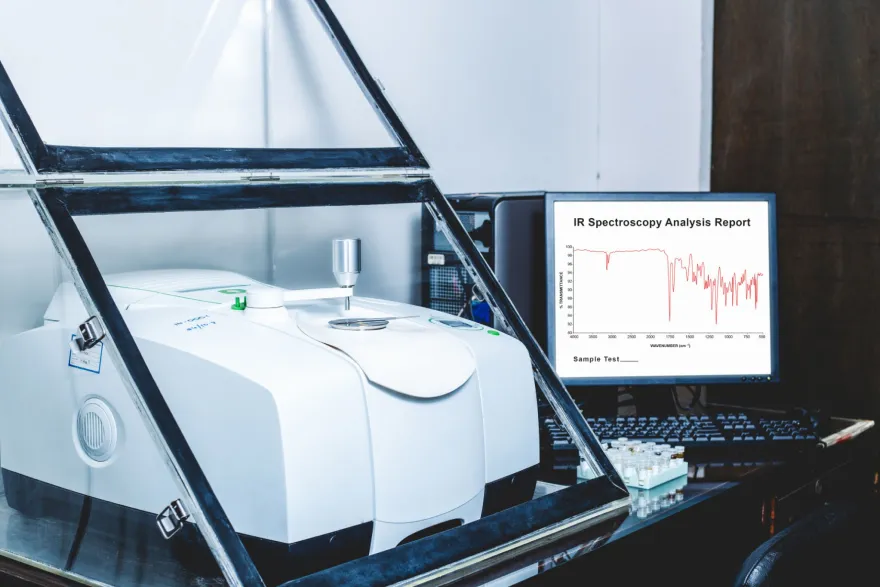
FTIR Analysis (Fourier Transform Infrared Spectroscopy) is a non-destructive spectroscopic method that uses infrared light to scan samples and measure their chemical composition.
Unlike elemental testing methods (such as SEM-EDS or ICP) that determine the elements present, FTIR reveals how those atoms are bonded together. It identifies functional groups, polymer backbones, additives, and degradation states.
Laboratories rely on FTIR analysis for:
- Unknown material identification: Rapid identification of plastics, elastomers, liquids, powders, and films.
- Contamination & residue analysis: Pinpointing surface stains, process residues, fibers, or particle contamination.
- Raw material verification: High-confidence identity testing of incoming chemical lots against reference library spectra.
- Oxidation and degradation profiling: Evaluating breakdown products, thermal stress, or environmental aging in oils, polymers, and coatings.
How FTIR Works: The Science of Molecular Fingerprinting
[ Broad-Band IR Source (10,000 - 100 cm⁻¹) ] ➔ [ Michelson Interferometer ] ➔ [ Sample Interaction ] ➔ [ Detector (Interferogram) ] ➔ [ Fourier Transform Math ] ➔ [ Final Spectrum (4000 - 400 cm⁻¹) ]
When an infrared beam passes through or reflects off a sample:
- Bond Vibration & Absorption: Chemical bonds absorb specific infrared frequencies that match their natural vibrational and rotational energy states (such as stretching, bending, and rocking modes).
- Interferometer Modulation: A Michelson interferometer with moving and fixed mirrors modulates all infrared wavelengths simultaneously, eliminating the slow scan times of old dispersive instruments.
- Fourier Transformation: The detector records an interferogram (intensity vs. optical path difference). A computer applies the Fourier Transform mathematical algorithm to convert this raw wave signal into a standard spectrum of Absorbance (or Transmittance) versus Wavenumber (cm⁻¹).
- Spectral Regions:
- Functional Group Region (4000 to 1500 cm⁻¹): Displays diagnostic absorption bands characteristic of specific bonds like O-H, N-H, C-H, C=O, and C≡N.
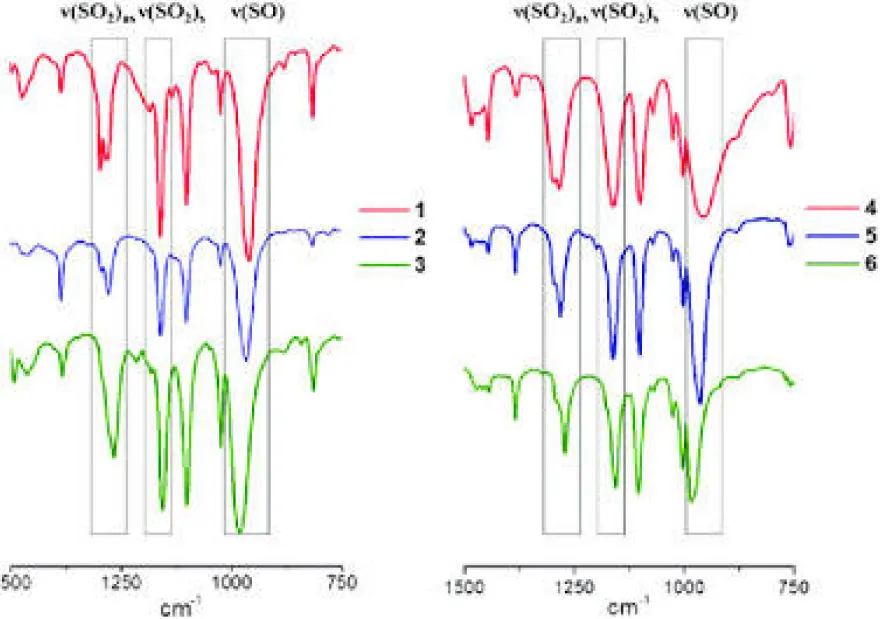
- Fingerprint Region (1500 to 400 cm⁻¹): Contains complex, multi-bond vibrational modes unique to the specific compound, allowing computer matching against extensive spectral databases.
Sample Introduction & Measurement Techniques
A major strength of modern FTIR analysis is the variety of sample handling techniques tailored to different physical states and sample geometries:
1. Attenuated Total Reflectance (ATR)
ATR has largely replaced traditional sample preparation because it requires minimal or no prep work.
- Mechanism: An infrared beam enters an optically dense crystal (such as Diamond, Zinc Selenide [ZnSe], or Germanium [Ge]) at an incident angle, causing internal reflections. An “evanescent wave” penetrates a few microns into the sample pressed tightly against the crystal face.
- Crystal Selection:
- Zinc Selenide (ZnSe): Highly versatile and durable for everyday liquids, pastes, and organic solids.
- Germanium (Ge): High refractive index with a shallow depth of penetration, making it ideal for heavily absorbing samples like carbon-black filled rubbers and dark polymers.
- Diamond: Extremely rugged for hard, abrasive materials and pellets.
2. Transmission Mode
The historic standard for transparent or prepared samples:
- Liquid cells with IR-transparent salt windows (NaCl, KBr).
- Powdered solids pressed into translucent KBr (Potassium Bromide) pellets.
- Thin solvent-cast films on infrared-transparent salt plates.
3. Microscopic FTIR (FTIR Microscopy)
When target particles or defects are too small for bulk sampling:
- Combines high-resolution optical microscopy with focused FTIR optics.
- Characterizes discrete contaminants, foreign particles, or micro-layers down to 10 to 50 microns in size.
- Can operate in microscopic ATR, transmission, or reflectance modes.
4. Specular & Diffuse Reflectance (DRIFTS)
- Specular Reflectance: Measures light bouncing directly off reflective surfaces at a single angle, ideal for thin organic coatings on metallic substrates.
- Diffuse Reflectance (DRIFTS): Captures light scattered by rough surfaces or matte powders, suitable for catalyst powders and weathered surfaces.
Qualitative vs. Quantitative FTIR
While FTIR is most widely recognized as a qualitative tool for chemical identification and library matching, it is also a reliable quantitative tool when reference standards are available:
- Qualitative Identification: Fast spectral search against databases containing over 250,000 reference standards (polymers, solvents, pharmaceuticals, minerals). Matches are reported as a percentage correlation.
- Quantitative Functional Group Analysis: By applying the Beer-Lambert Law, peak intensities directly correlate to the concentration of target chemical functionalities. Common quantitative use-cases include:
- Measuring water content in specialized oils and solvents.
- Quantifying the degree of oxidation, nitration, and soot loading in lubricating oils.
- Determining the ratio of copolymer blends (e.g., vinyl acetate content in EVA polymers).
Major Industrial Applications
| Industry | Common FTIR Applications |
| Plastics & Polymers | Identification of base resins (PE, PP, PET, Nylon), plasticizers, flame retardants, and recycled polymer purity. |
| Manufacturing & QC | Failure analysis, identifying foreign surface stains, discoloration, mold-release agent residues, and packaging film defects. |
| Pharmaceuticals | Raw material identity testing, excipient verification, polymorph screening, and counterfeit drug detection. |
| Automotive & Aerospace | Lubricating oil condition monitoring, hydraulic fluid degradation, gasket and elastomer characterization. |
| Coatings & Adhesives | Monitoring cure kinetics, epoxy cross-linking verification, and primer adhesion troubleshooting. |
Combining FTIR with Complementary Analytical Techniques
In comprehensive failure analysis and material investigations, FTIR provides the molecular identity, but pairing it with other laboratory tools delivers the complete chemical picture:
- FTIR + SEM/EDS: While FTIR characterizes the organic backbone and functional groups, Scanning Electron Microscopy / Energy Dispersive X-ray Spectroscopy (SEM/EDS) maps microscopic morphology and identifies inorganic elemental constituents.
- FTIR + GC-MS / LC-MS: FTIR screens the bulk matrix and major constituents, while chromatographic mass spectrometry isolates and identifies trace organic additives, degradation impurities, and volatile volatile organic compounds (VOCs).
Conclusion
FTIR analysis serves as an indispensable analytical technique for rapid, cost-effective, and non-destructive material characterization. Whether you are troubleshooting unexpected manufacturing defects, identifying unknown organic residues, or verifying incoming raw materials, FTIR provides clear molecular insight to maintain strict product quality.
Professional FTIR Testing Services at Chromatogen
Need dependable FTIR analysis, polymer identification, or contamination troubleshooting for your R&D or Quality Control projects?
Contact Chromatogen Analytical Solutions Today to consult with our spectroscopy experts and book your sample analysis.