
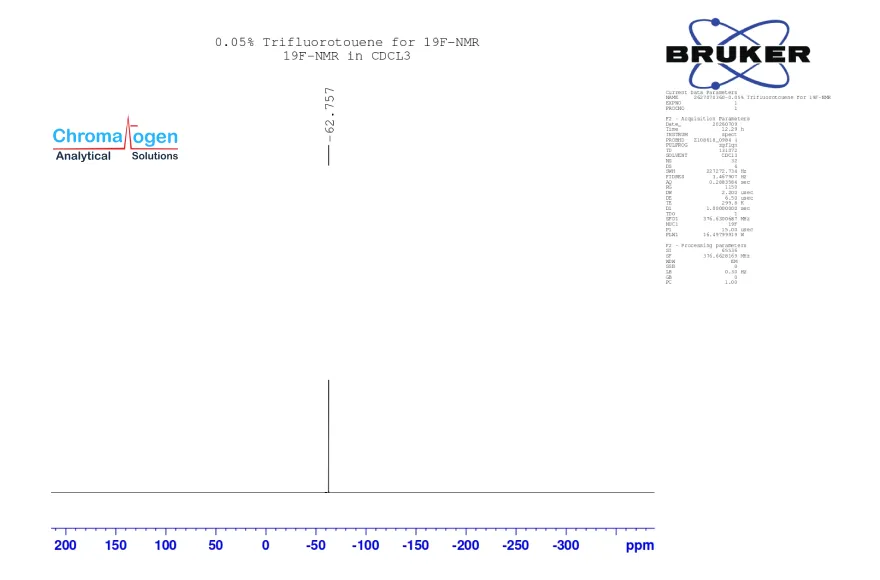
In modern pharmaceutical development, agrochemical research, and advanced materials science, the incorporation of fluorine atoms has become a powerful strategy to modify metabolic stability, lipophilicity, and biological activity. To analyze these specialized molecules, chemists rely on 19F NMR (Fluorine-19 Nuclear Magnetic Resonance) spectroscopy—one of the most sensitive and selective analytical techniques available.
Because fluorine is heavily featured in modern drug candidates and fluoropolymers, 19F NMR is an invaluable tool for structural verification and purity analysis in professional analytical testing laboratories.
What is 19F NMR Spectroscopy?
19F NMR spectroscopy focuses on the fluorine-19 isotope, which is the only stable isotope of fluorine found in nature.
It shares several striking characteristics with the proton (1H) nucleus that make it exceptionally user-friendly:
- 100% Natural Abundance: Just like phosphorus-31, fluorine-19 has a 100% natural abundance, delivering strong signals with high sensitivity and fast scan times.
- Spin-1/2 Nucleus: 19F possesses a nuclear spin of I = 1/2, providing sharp, well-resolved singlet and multiplet signals without quadrupole broadening.
- High Sensitivity: Its magnetogyric ratio is very high (about 83% that of a proton), making 19F NMR nearly as sensitive as 1H NMR.
- Massive Chemical Shift Range: While proton spectra span roughly 0 to 12 ppm, the 19F chemical shift window spans over 300 ppm. This wide dispersion means that even subtle electronic changes or distant structural variations result in distinct, well-separated peaks, virtually eliminating overlapping signal issues.
Key Applications of 19F NMR Analysis
- Pharmaceutical R&D & Drug Discovery: With a vast percentage of modern small-molecule drugs containing fluorine groups (such as trifluoromethyl, difluoromethyl, or aromatic fluorides), 19F NMR is routinely used to confirm molecular structures and track metabolic intermediates.
- Agrochemical Quality Control: Evaluating the precise composition, active isomer ratios, and trace impurities in fluorinated pesticides, herbicides, and specialized crop protection chemicals.
- Fluoropolymer & Materials Science: Analyzing fluoropolymer architectures, end-groups, branching ratios, and co-polymer compositions for high-performance industrial materials (like PTFE and fluorinated elastomers).
- Reaction Monitoring & Quantitative Analysis (qNMR): Tracking reaction yields in real time and assessing absolute purity without needing an identical reference standard.
Advantages in Laboratory Workflow
One of the greatest operational advantages of 19F NMR is the lack of background interference. Because biological matrices, common organic solvents (unless perfluorinated), and standard reagents rarely contain fluorine, 19F spectra are exceptionally clean. This allows chemists to study complex reaction mixtures or crude extracts directly with minimal sample workup.
Elevate Your Research with Chromatogen
Accurately acquiring and interpreting wide-range 19F spectra requires high-performance NMR spectrometers and deep technical proficiency.
At Chromatogen, our advanced testing laboratory provides high-resolution spectroscopic services designed to support your chemical synthesis, R&D, and quality assurance workflows.
Ready to optimize your analytical pipeline? Contact Chromatogen today to speak with our expert team.