
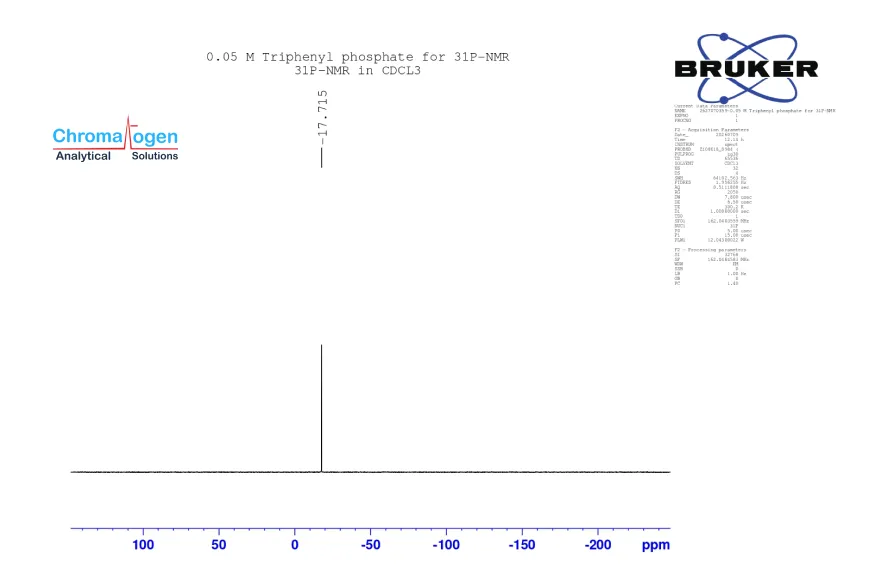
While Proton (1H) and Carbon (13C) NMR form the core of organic structural analysis, many specialized chemical compounds, catalysts, and biochemical agents rely on another critical element: phosphorus. 31P NMR (Phosphorus-31 Nuclear Magnetic Resonance) spectroscopy is a powerful, highly sensitive analytical technique used to identify and characterize phosphorus-containing molecules.
From tracking active pharmaceutical ingredients (APIs) and organophosphate catalysts to studying nucleic acids, 31P NMR is an essential tool in advanced analytical laboratories.
What is 31P NMR Spectroscopy?
31P NMR spectroscopy focuses on the phosphorus-31 isotope, which is the only stable isotope of phosphorus found in nature.
Key physical characteristics make 31P an ideal nucleus for NMR analysis:
- 100% Natural Abundance: Unlike carbon-13 (which sits at roughly 1.1%), phosphorus-31 has a 100% natural abundance, providing exceptionally strong signals and high sensitivity without requiring prolonged sample acquisition times.
- Spin-1/2 Nucleus: 31P possesses a nuclear spin of I = 1/2, resulting in sharp, well-defined spectral peaks free from complex quadrupole broadening complications.
- Wide Chemical Shift Range: The chemical shift window spans roughly 750 ppm (from approximately -500 to +250 ppm relative to an external 85% H3PO4 reference), allowing researchers to easily differentiate between diverse oxidation and coordination states.
Key Applications of 31P NMR Analysis
Because phosphorus is a central component in numerous chemical and biological systems, 31P NMR is heavily utilized across several industries:
- Organophosphorus Compounds & Synthesis: Widely used to characterize phosphines, phosphonates, phosphates, and phosphorus-containing reagents (such as Wittig and Mitsunobu reagents).
- Catalyst Speciation and Coordination Chemistry: Crucial for studying transition metal-phosphine complexes (involving palladium, platinum, rhodium, or ruthenium) used in homogeneous catalysis, allowing researchers to track active catalytic intermediates and ligand exchange dynamics.
- Pharmaceuticals & Biochemistry: Applied in analyzing nucleotide structures, nucleic acid building blocks, phospholipids, and phosphorus-masked prodrugs.
- Agrochemicals & Materials: Utilized for quality control and purity assessment of organophosphate pesticides, herbicides (like glyphosate derivatives), flame retardants, and polymer plasticizers.
Advantages in Laboratory Workflow
One of the practical benefits of 31P NMR is its simplicity in setup. Routine proton-decoupled spectra collapse complex splitting patterns into sharp, single resonances for each unique phosphorus environment, streamlining both quantitative integration and structural tracking. Furthermore, its fast acquisition times make it ideal for routine reaction monitoring and stability tests.
Accelerate Your Research with Chromatogen
Accurately interpreting phosphorus shifts, metal-ligand coordination changes, and trace impurities requires specialized instrumentation and seasoned spectroscopic expertise.
At Chromatogen, our advanced analytical testing facilities deliver precise, high-resolution NMR data tailored to your development and quality control needs.
Ready to streamline your chemical analysis? Contact Chromatogen today to connect with our analytical experts.