
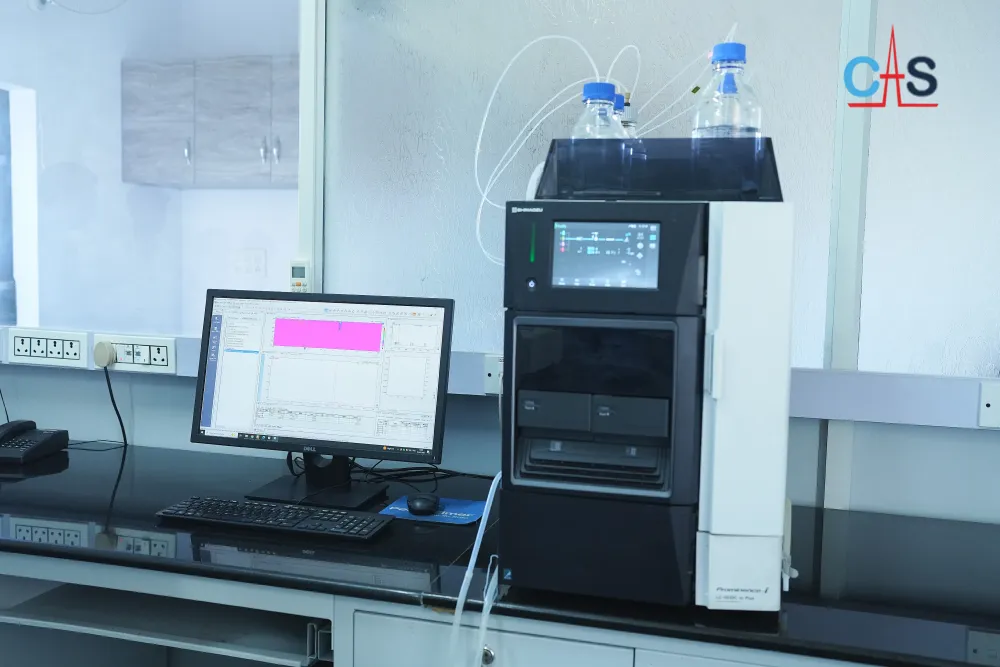
In quantitative chemical analysis and quality control, identifying individual compounds within complex liquid mixtures requires speed, precision, and high resolution. A High Performance Liquid Chromatograph (HPLC) is an advanced analytical instrument designed to separate, identify, and quantify chemical components in liquid samples under high pressure.
From ensuring pharmaceutical batch purity to detecting trace contaminants in food and water, HPLC systems serve as the cornerstone of modern testing laboratories worldwide. This comprehensive guide explores the working principle, key hardware components, modes of operation, and primary industrial applications of the High Performance Liquid Chromatograph.
What is a High Performance Liquid Chromatograph?
A High Performance Liquid Chromatograph (commonly abbreviated as HPLC) is a specialized analytical chemistry instrument that automates liquid chromatography. Unlike traditional gravity-fed column chromatography, HPLC uses high-pressure pumps—generating operational pressures typically ranging from 50 to 400 bar (700 to 5,800 psi)—to force a liquid solvent (mobile phase) containing the sample mixture through a tightly packed stationary phase column.
Because the stationary phase material consists of small particles (typically 3 to 5 micrometers in diameter), high pressure is required to maintain a steady flow rate. This fine packing material significantly increases the surface area for molecular interactions, yielding superior separation resolution and faster analysis times.
Working Principle of HPLC
The operational principle of a High Performance Liquid Chromatograph relies on the differential affinity of analyte molecules between two distinct phases:
- Mobile Phase: A liquid solvent or solvent mixture flowing through the system at a controlled rate.
- Stationary Phase: A solid or liquid-coated packing material contained tightly inside a stainless steel column.
When a liquid sample is injected into the mobile phase stream, it travels through the column. Individual chemical compounds interact differently with the stationary phase material based on their unique chemical properties (polarity, charge, size, or structural affinity).
- Strong Retention: Compounds that interact strongly with the stationary phase spend more time inside the column and elute later.
- Weak Retention: Compounds with weaker interactions pass quickly through the column with the mobile phase and elute earlier.
As separated compounds emerge from the column, they pass through a detector, producing electronic signals plotted as peaks on a chromatogram.
Core Components of an HPLC System
A modern High Performance Liquid Chromatograph consists of several integrated hardware modules working in tandem:
1. Solvent Reservoir & Degasser
- Function: Holds the mobile phase solvents (such as water, acetonitrile, or methanol).
- Importance: The inline degasser removes dissolved air to prevent gas bubble formation in the high-pressure pump and flow cell, which could cause pressure fluctuations or detector noise.
2. High-Pressure Pump
- Function: Delivers a constant, pulse-free flow of mobile phase through the column against high backpressure.
- Operation Modes: Operates in isocratic mode (constant solvent ratio throughout the run) or gradient mode (solvent composition changes over time to resolve complex mixtures).
3. Autosampler / Injector
- Function: Introduces precise microliter volumes of the liquid sample into the high-pressure mobile phase stream without interrupting system pressure.
4. Chromatographic Column & Oven
- Function: The core module where chemical separation occurs.
- Temperature Control: A thermostatted column oven maintains a constant temperature (typically 30°C to 40°C) to ensure reproducible retention times and optimal viscosity.
5. Detector
Measures the concentration of separated components exiting the column. Common HPLC detector types include:
- UV/Vis & Photodiode Array (PDA/DAD): Measures light absorption; PDA records full spectral data simultaneously.
- Fluorescence Detector (FLD): Offers ultra-high sensitivity for naturally or derivatized fluorescent compounds.
- Refractive Index Detector (RID): Universal detector for compounds lacking chromophores (e.g., sugars, polymers).
- Mass Spectrometer (LC-MS): Delivers mass-to-charge ratio ($m/z$) measurement for exact identification and trace quantification.
6. Data System & Software
- Function: Controls instrument hardware, records electronic detector responses, calculates peak retention times, and integrates peak areas for quantitative calculations.
Primary Modes of Liquid Chromatography
Depending on the chemical nature of the target analytes, HPLC can be configured in different operational modes:
| Mode | Mobile Phase | Stationary Phase | Separation Mechanism |
| Reversed-Phase (RP-HPLC) | Polar (Water + Methanol/Acetonitrile) | Non-polar (C18 / Octadecylsilane) | Based on hydrophobic interactions. Non-polar compounds elute last. |
| Normal-Phase (NP-HPLC) | Non-polar (Hexane / Isopropanol) | Polar (Silica gel / Amino) | Based on polar interactions. Polar compounds elute last. |
| Ion-Exchange (IEC) | Aqueous Buffer | Charged resin (Cation / Anion exchange) | Based on net molecular charge. |
| Size-Exclusion (SEC / GPC) | Liquid Solvent | Porous polymer gel beads | Based on molecular size/weight. Large molecules elute first. |
Note: Reversed-Phase HPLC (RP-HPLC) accounts for over 75% of all analytical liquid chromatography applications due to its versatility and compatibility with aqueous samples.
Key Advantages of High Performance Liquid Chromatography
Modern analytical laboratories prioritize HPLC testing for several reasons:
- High Separation Resolution: Separates structurally similar compounds, structural isomers, and minor process impurities cleanly.
- Quantitative Accuracy: Delivers highly reproducible retention times and precise linear quantification across a wide dynamic range.
- Automated High-Throughput Processing: Modern autosamplers allow unattended 24/7 analysis of dozens or hundreds of sample vials.
- Non-Destructive Detection: Samples passing through optical detectors (UV/Vis, FLD, RID) remain intact, allowing collection for downstream purification or further testing.
- Thermally Sensitive Compound Handling: Unlike Gas Chromatography (GC), HPLC operates at room temperature or moderate heat, making it suitable for thermally unstable, polar, or non-volatile compounds (e.g., proteins, peptides, vitamins, antibiotics).
Major Industrial Applications
High Performance Liquid Chromatographs are vital workhorses across diverse scientific and commercial industries:
1. Pharmaceutical Quality Control & R&D
- Assay Testing: Verifies the active constituent concentration in tablet, liquid, and injectable dosage forms.
- Dissolution Testing: Quantifies drug release rates over time in oral formulations.
- Stability Studies & Impurity Profiling: Monitors degradation product accumulation over shelf-life under various storage conditions.
2. Food & Agriculture
- Nutritional Content Analysis: Quantifies water-soluble and fat-soluble vitamins, sugars, organic acids, and artificial preservatives.
- Contaminant Screening: Detects trace mycotoxins (e.g., aflatoxins), pesticide residues, and veterinary drug residues in food matrices.
3. Environmental Testing
- Water & Soil Monitoring: Identifies herbicides, polycyclic aromatic hydrocarbons (PAHs), synthetic detergents, and industrial pollutants in environmental samples.
4. Forensic & Clinical Diagnostics
- Therapeutic Drug Monitoring (TDM): Measures drug levels in patient plasma to optimize clinical dosing.
- Toxicology Screening: Detects illicit drugs, toxins, and metabolites in biological fluids.
HPLC vs. UHPLC vs. GC: Quick Comparison
| Feature | HPLC | UHPLC | GC |
| Full Name | High Performance Liquid Chromatograph | Ultra-High Performance Liquid Chromatograph | Gas Chromatograph |
| Operating Pressure | Up to 400 bar | Up to 1,200–1,500 bar | Low (Gas Flow Pressure) |
| Particle Size | $3 – 5 \ \mu\text{m}$ | $< 2 \ \mu\text{m}$ | Capillary Column Coating |
| Sample Requirement | Liquid / Dissolved compounds | Liquid / Dissolved compounds | Volatile / Thermally stable compounds |
| Analysis Speed | Standard (10–30 min) | Rapid (2–5 min) | Standard (15–45 min) |
Conclusion
The High Performance Liquid Chromatograph remains an essential analytical tool in modern laboratories. By combining high-pressure fluidics, specialized stationary phase columns, and high-sensitivity detectors, HPLC systems deliver defensible, reproducible data for complex sample analysis.
Whether developing novel pharmaceuticals, verifying food safety, or analyzing trace environmental contaminants, understanding HPLC principles and applications enables laboratories to achieve rigorous quality compliance.
Partner with Chromatogen for Professional HPLC Services
Need precise HPLC assay testing, method development, or purity profiling for your R&D or Quality Assurance projects?
Contact Chromatogen Analytical Solutions Today to consult with our expert analytical chemists and book your sample analysis.