
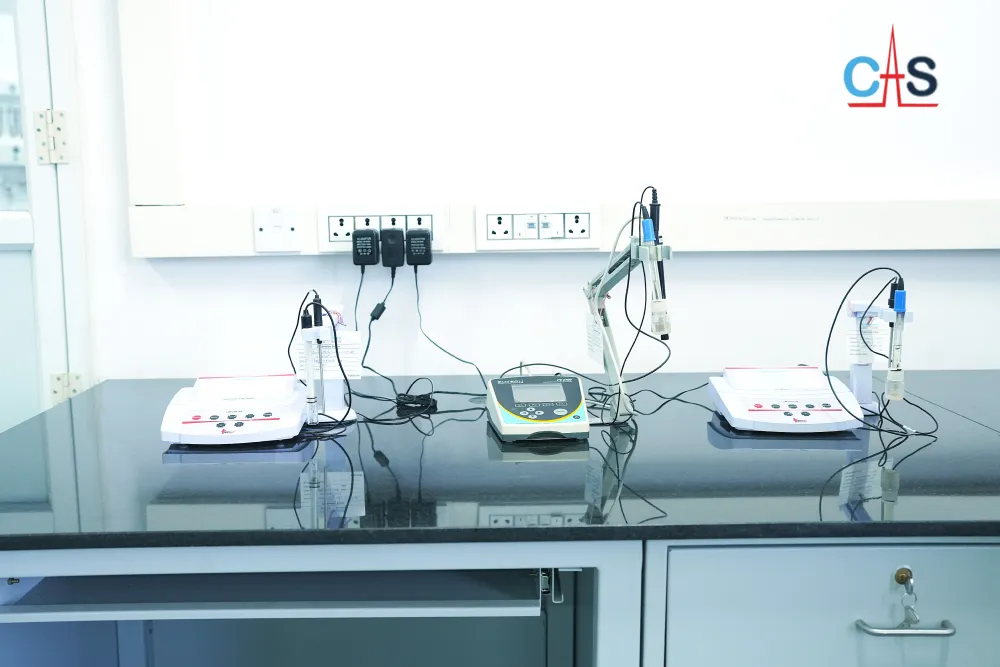
In pharmaceutical formulation, chemical synthesis, environmental monitoring, and water quality testing, electrochemistry parameters serve as foundational indicators of product stability and chemical integrity. pH and conductivity testing services utilizing research-grade multi-parameter benchtop meters—such as the Eutech PC 2700—deliver the measurement accuracy, temperature compensation, and regulatory traceability required for rigorous quality control workflows.
Whether testing Purified Water (PW) and Water for Injection (WFI), checking batch-to-batch consistency of liquid formulations, or evaluating industrial effluents, high-accuracy electrochemical analysis is indispensable. This guide covers the working principles of pH and electrical conductivity measurement, key technical capabilities of the PC 2700, and essential industrial applications.
Why pH and Conductivity Measurements Matter
Electrochemical measurements reveal critical chemical and physical characteristics of liquid samples:
- pH (Potential of Hydrogen): Measures the hydrogen ion activity in aqueous solutions on a logarithmic scale from -2.000 to 20.000. It governs chemical reaction rates, chemical solubility, biological efficacy, and product stability.
- Conductivity (Electrical Conductivity / EC): Measures a solution’s ability to conduct an electric current, directly proportional to the concentration of dissolved ionic species, total dissolved solids (TDS), and salinity.
- Resistivity and Salinity: Critical secondary parameters derived from conductivity to confirm water purity levels in high-grade pharmaceutical and semiconductor applications.
Working Principles of pH and Conductivity Analysis
[ Dual-Channel Benchtop System (PC 2700) ]
       ├── Channel 1: Glass Combination Electrode (mV / pH) ──► Nernst Equation
       └── Channel 2: 4-Cell Conductivity Probe (µS/cm / mS/cm) ──► Conductance Cell Constant
1. The Principle of pH Measurement (The Nernst Equation)
pH determination relies on a glass combination electrode containing an internal reference element and a pH-sensitive glass membrane. When immersed in a solution, an electrical potential difference develops across the membrane proportional to hydrogen ion activity, calculated via the Nernst Equation:
E = E₀ – (2.303 · R · T / F) · pH
Where:
- E = Measured potential (mV)
- E₀ = Standard potential of the reference electrode (mV)
- R = Universal gas constant
- T = Absolute temperature (Kelvin)
- F = Faraday constant
Because the slope of this potential response varies with temperature (approx. 59.16 mV/pH unit at 25°C), Automatic Temperature Compensation (ATC) is required for high-accuracy results.
2. The Principle of Electrical Conductivity Measurement
Conductivity ($κ$ or sigma) measures the flow of alternating current between electrode plates separated by a fixed distance:
Conductivity (κ) = G · K
Where:
- G = Measured electrical conductance (Siemens, S)
- K = Cell constant of the probe (cm⁻¹)
The PC 2700 utilizes advanced 4-cell conductivity probes, which minimize polarization errors and resistance effects across wide dynamic ranges compared to standard 2-plate cells.
Technical Highlights: Why the PC 2700 Benchtop Meter Delivers Superior Accuracy
The Eutech PC 2700 is a dual-channel, multi-parameter benchtop instrument designed for high-throughput analytical testing laboratories and research facilities.
Key Features of the PC 2700 System
- Dual-Channel Simultaneous Measurement: Measures and displays pH, Ion concentration, Conductivity, TDS, Salinity, Resistivity, and Temperature simultaneously on a custom backlit screen without swapping meters.
- Multi-Point Calibration: Supports up to 6-point pH calibration with standard USA, NIST, or custom buffer sets, and up to 5-point conductivity calibration across distinct measurement ranges for unmatched linearity.
- Advanced Temperature Compensation: Offers linear and non-linear pure water temperature compensation modes, vital for testing high-purity pharmaceutical waters according to pharmacopeial guidelines.
- GLP / GMP Compliance Ready: Automatically logs calibration data (date, time, calibration points, electrode slope, and offset values) with a non-volatile memory holding up to 500 data sets.
- High Resolution & Sensitivity: Features selectable resolution up to 0.001 pH units and auto-ranging conductivity from 0.050 µS/cm to 500.0 mS/cm.
Comprehensive Electrochemistry Testing Services
Testing laboratories equipped with the PC 2700 provide specialized services covering routine QC and complex testing protocols:
| Service Category | Measurable Parameters | Regulatory Standards |
| Pharmaceutical Water Quality | Conductivity, Resistivity, pH, Temperature | USP <645>, USP <791>, IP, EP |
| Formulation Stability & Batch Release | pH (0.001 precision), mV, Buffer capacity | Pharmacopeial Monographs |
| Total Dissolved Solids (TDS) & Salinity | TDS (ppm/ppt), Salinity (ppt), Specific gravity | Standard Methods / ISO |
| Ion-Selective Concentration | Direct potentiometry for specific dissolved ions | ASTM / In-house Protocols |
| Effluent & Wastewater Profiling | pH, EC, TDS, Temperature | CPCB, EPA, ISO 10523 |
Industrial Applications
1. Pharmaceuticals & Biotechnology
- USP <645> Water Testing: Stage 1, Stage 2, and Stage 3 offline conductivity testing of Purified Water (PW) and Water for Injection (WFI).
- Buffer & Media Preparation: Verifying physiological pH and osmolarity/conductivity of dissolution buffers, culture media, and injectable solutions.
2. Environmental & Water Treatment
- Monitoring surface water, groundwater, and treated wastewater discharge compliance.
- Measuring reverse osmosis (RO) permeate efficiency and deionization system performance.
3. Food, Beverages & Agriculture
- Monitoring acidity and salinity in dairy products, sauces, fruit juices, and fermented beverages.
- Hydroponics and agricultural soil slurry testing for electrical conductivity and nutrient availability.
4. Chemicals & Electroplating
- Monitoring acid/base concentrations in chemical processing and electroplating bath electrolyte levels.
Why Choose Professional Electrochemistry Testing Services?
Accurate pH and conductivity measurements require more than basic handheld meters. Outsource testing to a professional laboratory to ensure:
- Traceable Calibration: Probes are calibrated daily against NIST-traceable reference standards and certified buffer solutions (pH 1.68, 4.01, 7.00, 10.01, 12.45).
- Proper Electrode Maintenance: Certified chemists ensure hydration maintenance, junction unblocking, and accurate probe cell-constant verification.
- Audit-Compliant Documentation: Full test certificates containing raw readings, reference temperatures, calibration slope efficiencies, and analyst sign-offs.
Summary
Electrochemical parameters like pH and conductivity are fundamental quality indicators that demand analytical precision. Utilizing high-end benchtop systems like the Eutech PC 2700, modern testing laboratories deliver reliable, compliant, and defensible data to keep manufacturing and R&D operations on track.
Partner with Chromatogen for Precision Electrochemical Testing
Looking for reliable pH determination, USP <645> water conductivity testing, or buffer analysis using the PC 2700?
Contact Chromatogen Analytical Solutions Today to discuss your analytical testing requirements and schedule sample analysis.