
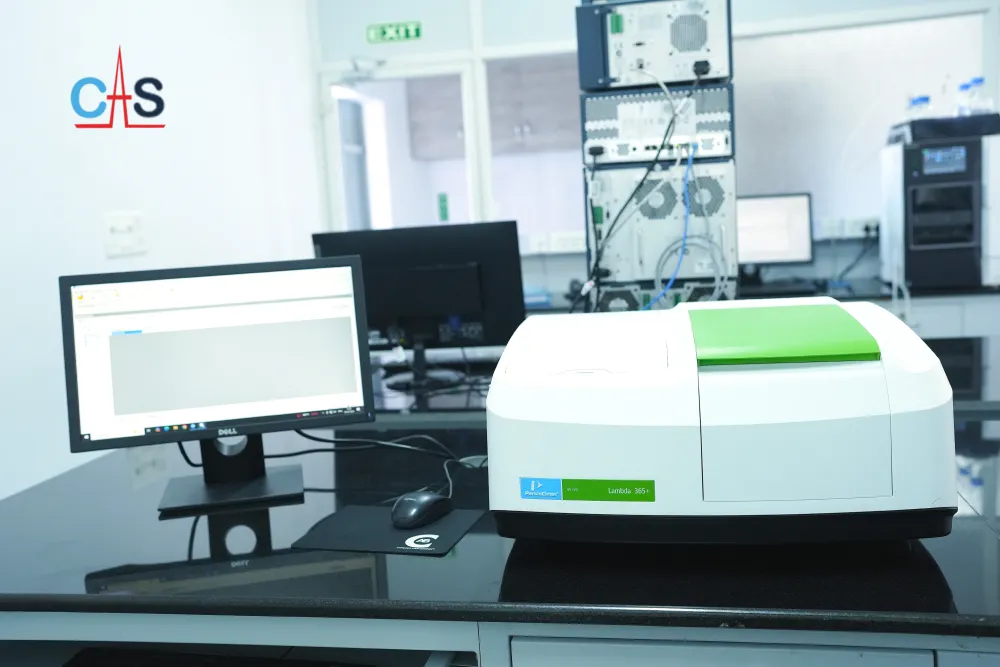
In pharmaceutical quality control, chemical synthesis, and materials testing, rapid and non-destructive quantification of active molecules is vital. UV-Vis spectroscopy services utilizing advanced double-beam spectrophotometers—such as the PerkinElmer LAMBDA 365+—provide the precision, photometric linearity, and regulatory compliance required for critical analytical workflows.
Whether you need pharmacopeial assay quantification, optical purity evaluation, kinetic reaction monitoring, or raw material release testing, high-performance ultraviolet-visible spectrophotometry delivers rapid, reproducible results. This guide explores the working principles, advanced capabilities of the LAMBDA 365+, and key industrial applications of professional UV-Vis testing services.
What is UV-Vis Spectroscopy?
UV-Vis (Ultraviolet-Visible) Spectroscopy is an absorption spectroscopy technique that measures the attenuation of a beam of light after passing through a sample or reflecting from a sample surface.
The method operates in the ultraviolet (approx. 190 to 400 nm) and visible (approx. 400 to 1100 nm) regions of the electromagnetic spectrum. Molecules containing conjugated double bonds, aromatic rings, or transition metal complexes absorb specific wavelengths of light, promoting ground-state electrons to higher-energy excited states (π → π* or n → π* transitions).
Fundamental Governing Principle: The Beer-Lambert Law
Quantitative determination in UV-Vis spectroscopy is governed by the Beer-Lambert Law:
A = ε · b · c
Where:
- A = Measured Absorbance (unitless)
- ε = Molar absorptivity / extinction coefficient (L · mol⁻¹ · cm⁻¹)
- b = Path length of the quartz cuvette cell (cm, typically 1 cm)
- c = Concentration of the absorbing analyte (mol/L)
Because absorbance is directly proportional to concentration over a validated linear dynamic range, UV-Vis spectroscopy enables accurate quantitative analysis with minimal sample preparation.
Technical Highlights: Why the PerkinElmer LAMBDA 365+ Delivers Superior Data
The PerkinElmer LAMBDA 365+ is a high-performance, double-beam UV/Vis spectrophotometer engineered specifically for regulated laboratories, pharmaceutical QC, and advanced R&D.
[ Light Sources: D2 + Tungsten ] ➔ [ Monochromator ] ➔ [ Beam Splitter ] ➔ [ Dual Beams: Sample & Reference ] ➔ [ Dual Photodiode Detectors ]
Key Advantages of the LAMBDA 365+ System
- True Double-Beam Optics: Features dedicated sample and reference beams that measure simultaneously. This optical geometry compensates in real time for lamp fluctuations and solvent background variations, delivering superior baseline stability.
- Variable Spectral Bandwidth (SBW): Adjustable slit widths (e.g., 0.5, 1, 2, 4, 5 nm) allow operators to optimize the system for either ultra-high spectral resolution (resolving sharp, fine-structure peaks) or maximum photometric sensitivity.
- Low Stray Light & High Photometric Range: Advanced monochromator optics minimize stray light, maintaining linear calibration curves at high optical densities (up to 4.0 A or higher), which reduces the need for extensive sample dilutions.
- 21 CFR Part 11 Compliance: Powered by software built for regulated environments, offering complete audit trails, electronic signatures, user access controls, and data integrity safeguards required by regulatory authorities (FDA, EMA, DCGI).
- Fast Scanning Speed: Rapid scan capabilities enable real-time kinetic studies, degradation tracking, and high-throughput sample batch verification.
Comprehensive UV-Vis Analytical Services Offered
Professional testing laboratories equipped with the LAMBDA 365+ provide a versatile spectrum of testing capabilities:
| Service Category | Typical Deliverables / Objectives | Standard References |
| Assay & Potency Testing | Quantification of APIs, finished dosage forms, and raw chemicals against certified reference standards. | USP, IP, BP, EP Monographs |
| Identification & λmax Verification | Confirmation of chemical identity via absorption maxima (λmax), spectral matching, and absorbance ratios. | Pharmacopeial ID Tests |
| Dissolution Sample Analysis | High-throughput absorbance measurement of active drug release profiles from dissolution vessels. | USP <711> |
| Colorimetric & Biochemical Assays | Protein quantification (BCA, Bradford, Lowry assays), nucleic acid purity (A260 / A280 ratio), and enzyme kinetics. | ISO/IEC 17025 Protocols |
| Method Development & Validation | Full validation covering Specificity, Linearity Range, Accuracy, Precision, LOD/LOQ, and Solution Stability. | ICH Q2(R1) Guidelines |
Key Industries Served
1. Pharmaceuticals & Biotechnology
- Active ingredient content verification and batch release testing.
- Impurity screening and colorimetric limit tests.
- Nucleic acid and protein concentration determination in bioprocessing.
2. Chemicals & Agrochemicals
- Active content determination in fertilizers, pesticides, and technical concentrates.
- Monitoring synthesis progress, dye concentration, and bath exhaustion in textile chemistry.
3. Food, Beverages & Nutraceuticals
- Quantification of natural pigments (anthocyanins, carotenoids, chlorophyll).
- Monitoring oxidation levels in edible oils (peroxide value and specific UV absorbances K232 / K270).
- Synthetic food color identification and preservative assays.
4. Environmental & Water Testing
- Trace nutrient analysis (nitrates, phosphates, sulfates) via standard colorimetric reactions.
- Measurement of chemical oxygen demand (COD) and phenolic compounds in industrial effluents.
Why Outsource to a Professional UV-Vis Testing Laboratory?
Partnering with an accredited analytical testing facility equipped with the PerkinElmer LAMBDA 365+ provides distinct operational benefits:
- Certified Calibration & Qualification: Instruments undergo regular qualification (OQ/PQ) using traceable holmium oxide and neutral density filters to guarantee wavelength accuracy and photometric linearity.
- Audit-Ready Documentation: Clients receive comprehensive certificates of analysis (CoAs) complete with raw spectral overlays, calibration regression statistics (R² ≥ 0.999), and analyst sign-offs.
- Cost-Effective Turnaround: Fast sample processing eliminates internal testing bottlenecks, keeping product release schedules and research milestones on track.
Summary
Ultraviolet-Visible spectroscopy remains one of the most reliable and efficient analytical tools in modern chemical testing. By leveraging the optics and compliance features of the PerkinElmer LAMBDA 365+, analytical laboratories deliver the data integrity and precision necessary for regulatory approval and product quality assurance.
Request UV-Vis Testing Services at Chromatogen
Need dependable UV-Vis analysis, assay determination, or ICH method validation on the PerkinElmer LAMBDA 365+?
Contact Chromatogen Analytical Solutions Today to discuss your testing requirements with our spectroscopy specialists and receive a fast quote.