
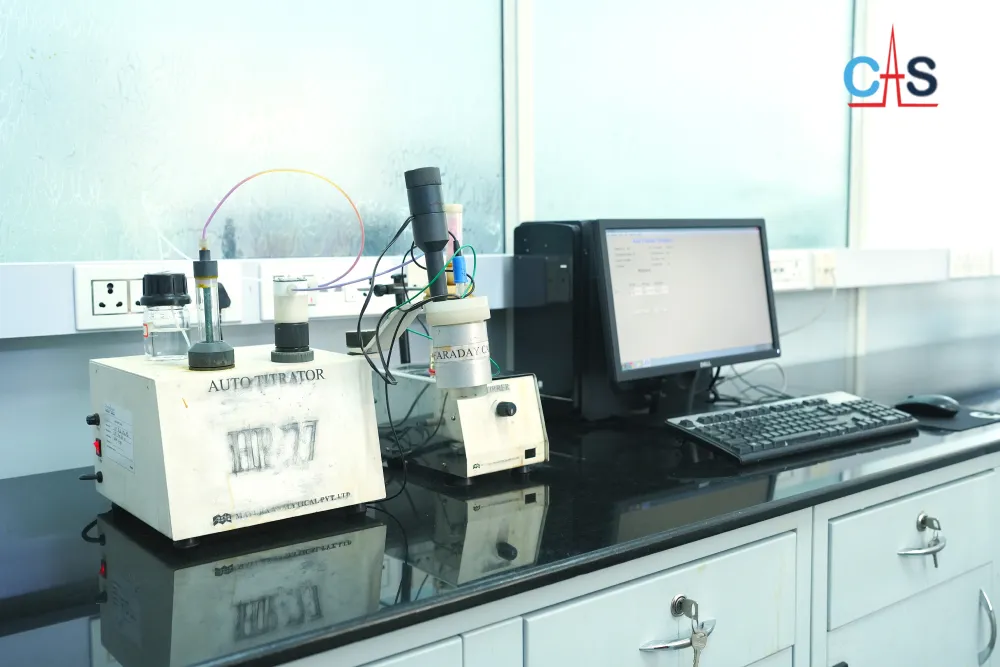
In pharmaceutical quality control, chemical manufacturing, and high-purity materials science, accurate moisture determination is critical. Karl Fischer Coulometric Titration (KF-MC) is the definitive analytical technique for measuring trace amounts of water (moisture content) down to parts-per-million (ppm) levels.
Unlike volumetric Karl Fischer methods that dose iodine from a burette, coulometric Karl Fischer generates iodine electrochemically in situ, providing unmatched sensitivity, precision, and reproducibility for low-moisture samples.
What is Coulometric Karl Fischer Titration?
Karl Fischer Coulometric Titration is a quantitative chemical method based on the quantitative reaction between water and iodine in the presence of sulfur dioxide and an organic base (such as imidazole).
In the coulometric technique, no iodine-containing titrant is added from a burette. Instead, iodine is generated electrolytically at an anode inside the sealed titration cell via the oxidation of iodide ions:
2 I⁻ → I₂ + 2 e⁻
According to Faraday’s law of electrolysis, exactly one mole of iodine reacts with one mole of water:
H₂O + I₂ + SO₂ + CH₃OH + 3 RN → [RN(H)]SO₄CH₃ + 2 [RN(H)]I
Because the generation of iodine is controlled by electrical current over time, the total water content is calculated directly from the electrical charge (in Coulombs) consumed to reach the titration endpoint, adhering strictly to Faraday’s Law.
Key Differences: Coulometric (MC) vs. Volumetric KF
| Feature | Coulometric KF (KF-MC) | Volumetric KF |
| Primary Use Case | Trace moisture analysis (ppm levels) | Moderate to high water content ($0.1\%$ to $100\%$) |
| Measuring Range | Typically $1 \text{ ppm}$ to $5\%$ ($\approx 10 \ \mu\text{g}$ to $10 \text{ mg}$ water) | $100 \text{ ppm}$ to $100\%$ water |
| Iodine Source | Generated electrochemically via electrolysis inside the cell | Dosed from a mechanical glass burette |
| Titer Standardization | Not required (calculated directly from electrical current) | Required daily using standard water/sodium tartrate |
| Sample Handling | Highly sensitive; best for low-moisture liquids, gases, and sealed extracts | Flexible for powders, pastes, and high-water matrices |
Core Instrumentation & Cell Configuration
A coulometric Karl Fischer system consists of a precision current generator, a sealed glass titration vessel, a dual-platinum pin indicator electrode, and an integrated magnetic stirrer.
[ Sealed Coulometric Cell ]
       ├── Generator Electrode (Anode & Cathode) ──► Generates I₂ via Electrolysis
       ├── Platinum Indicator Electrode ────────────► Detects Endpoint (Potentiometry)
       └── Sealed Septum Port ──────────────────────► Syringe Injection / Evaporator Inlet
Cell Types: With or Without Diaphragm
- Diaphragm Cells (Standard): Feature a ceramic membrane separating the anode compartment from the cathode compartment. This prevents secondary side reactions caused by iodine migrating back from the cathode. Essential for accurate trace analysis of difficult matrices (oils, amines, etc.).
- Diaphragm-less Cells: Single-compartment cells using a specialized reagent system. They offer faster stabilization times and require less maintenance, making them ideal for routine organic solvents and general non-reactive samples.
Comprehensive KF-MC Analytical Services Offered
Analytical testing laboratories utilize coulometric Karl Fischer systems to deliver precise moisture profiling across diverse industries:
| Service Category | Typical Sample Types | Target Specification / Range |
| Active Pharmaceutical Ingredients (APIs) | Dry powders, lyophilized cakes, sterile raw materials | Low ppm moisture compliance (USP / EP specs) |
| Organic Solvents & Reagents | Anhydrous solvents (methanol, acetonitrile, toluene, DMF) | $< 10 \text{ ppm}$ to $0.1\%$ water limits |
| Oils, Fats & Lubricants | Transformer oils, silicone oils, cosmetic bases, biodiesel | Trace water determination per ASTM / ISO standards |
| Polymers & Resins (via Oven) | Plastic pellets, engineering resins, films (using KF oven coupled to MC cell) | Moisture release at elevated temperatures ($100^\circ\text{C} – 250^\circ\text{C}$) |
| Electronics & Specialty Gases | Fluorinated gases, specialty chemicals, lithium-ion battery electrolytes | Gas sampling bulb introduction into coulometric cell |
Best Practices for Accurate Coulometric KF Analysis
- Strict Exclusion of Atmospheric Moisture: Because coulometric cells measure trace water down to microgram levels, the titration cell must remain hermetically sealed. All sample additions must be performed rapidly via gas-tight syringes through a silicone septum.
- Proper Sample Selection & Dissolution: Insoluble solids or hygroscopic powders cannot be added directly if they do not dissolve in methanol-based anolytes; instead, they require external extraction or a Karl Fischer Oven (vaporization) module where moisture is thermally driven into the titration cell by dry carrier gas.
- Blank Correction: Pre-titrating the cell removes residual moisture. For syringe injections or boat additions, method blanks must be accounted for to subtract background moisture introduced from ambient air or syringe handling.
Summary
Karl Fischer Coulometric Titration (KF-MC) is the undisputed gold standard for ultra-low moisture quantification. By combining electrolytic iodine generation with Faraday’s law, coulometric KF eliminates the need for manual titrant standardization while delivering exceptional accuracy for high-purity chemicals, solvents, and pharmaceuticals.
Partner with Chromatogen for Coulometric KF Moisture Testing
Need precise trace moisture analysis, solvent water content testing, or polymer KF oven testing for your quality control or stability protocols?
Contact Chromatogen Analytical Solutions Today to consult with our analytical chemistry team and schedule your sample testing in Mysuru.