
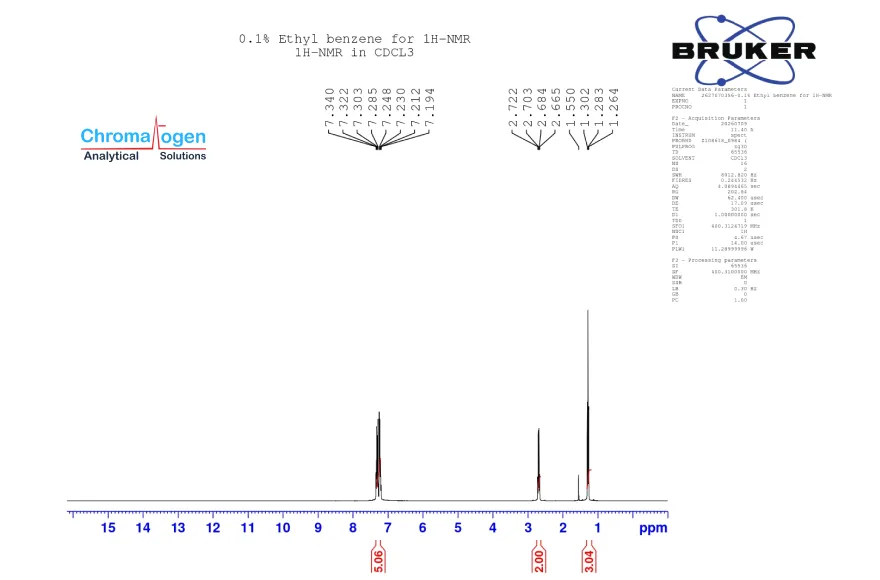
In the realm of organic chemistry and pharmaceutical research, knowing the elemental composition of a compound is only half the battle. The true challenge lies in understanding how those atoms are connected in three-dimensional space. Enter 1H NMR (Proton Nuclear Magnetic Resonance) spectroscopy—one of the most powerful and non-destructive analytical techniques available for molecular structure elucidation.
Whether you are synthesizing a novel drug candidate, verifying a polymer structure, or checking chemical purity, 1H NMR is an indispensable tool in the analytical chemist’s toolkit.
What is 1H NMR Spectroscopy?
1H NMR spectroscopy is an analytical technique that exploits the magnetic properties of hydrogen nuclei (protons, 1H). Because almost all organic molecules contain hydrogen atoms, proton NMR provides a direct window into the carbon-hydrogen framework of a molecule.
When placed in a powerful magnetic field and irradiated with radiofrequency (RF) pulses, hydrogen nuclei absorb energy and resonate at frequencies determined by their local electronic environment. This phenomenon allows scientists to map out the exact molecular skeleton.
Key Components of a 1H NMR Spectrum
Interpreting a 1H NMR spectrum involves analyzing four primary parameters:
- Chemical Shift (δ, measured in ppm): The position of a signal indicates the electronic environment surrounding a proton. Protons near electronegative atoms (like oxygen or nitrogen) experience ” deshielding” and shift downfield (higher ppm), while aliphatic protons appear upfield (lower ppm).
- Integration (Peak Area): The area under each peak is proportional to the number of protons contributing to that signal. Integration allows chemists to determine the precise ratio of different hydrogen environments in the molecule.
- Multiplicity (Spin-Spin Splitting): Peaks often split into multiplets (doublets, triplets, quartets) due to the magnetic influence of neighboring non-equivalent protons. This is governed by the n+1 rule and reveals which protons are adjacent to one another.
- Coupling Constant (J, in Hz): The distance between peaks in a multiplet represents the coupling constant, giving structural details about stereochemistry and spatial orientation.
Core Applications of 1H NMR Analysis
1H NMR is widely implemented across multiple industries for diverse analytical needs:
- Structure Elucidation: Determining the exact chemical structure of unknown synthesis products, natural extracts, or impurities.
- Purity Assessment & Quantitative NMR (qNMR): Measuring the absolute purity of active pharmaceutical ingredients (APIs) and reference standards without needing a 100% identical reference compound.
- Reaction Monitoring: Tracking the progress of chemical reactions in real-time to identify intermediates and optimize yields.
- Quality Control: Ensuring batch-to-batch consistency in chemical manufacturing, polymers, and fine chemicals.
Why Professional 1H NMR Testing Matters
While acquiring a 1H NMR spectrum is routine, accurate interpretation requires high-field instrumentation, flawless sample preparation, and seasoned analytical expertise. Complex spectra often feature overlapping peaks, second-order effects, or solvent interference that can mislead inexperienced analysts.
At Chromatogen, our state-of-the-art analytical testing laboratory delivers high-resolution NMR data engineered for absolute precision. Backed by advanced spectroscopic infrastructure and expert chromatographers, we help research institutions, pharmaceutical companies, and chemical industries decode complex molecular structures with confidence.
Unlock Precise Molecular Insights with Chromatogen
Accurate data is the backbone of successful chemical research and industrial compliance. If you are looking for reliable, high-precision 1H NMR, HRMS, or GC-MS testing services, partner with the experts.
Contact Chromatogen today to discuss your analytical testing requirements and accelerate your research pipeline.