While Proton (1H) NMR spectroscopy provides a brilliant look at the hydrogen framework of a molecule, it doesn’t tell the whole story. To fully map out the carbon backbone of an organic compound, chemists rely on its companion technique: 13C NMR (Carbon-13 Nuclear Magnetic Resonance) spectroscopy.
Essential for comprehensive organic chemistry, pharmaceutical R&D, and chemical manufacturing, 13C NMR is a cornerstone of modern molecular structure elucidation.
What is 13C NMR Spectroscopy?
13C NMR spectroscopy is an analytical technique focused on the carbon-13 isotope. Unlike the dominant 12C isotope (which is NMR-inactive because it has an even number of protons and neutrons), the 13C isotope possesses a nuclear spin, making it visible to magnetic resonance.
However, because the natural abundance of carbon-13 is only about 1.1%—combined with its lower gyromagnetic ratio compared to protons—13C NMR inherently requires more scans and higher instrument sensitivity than 1H NMR. Despite these challenges, the wealth of structural data it provides is well worth the effort.
Key Advantages of 13C NMR Analysis
- Direct Carbon Backbone Insight: It maps the primary carbon skeleton of a molecule, confirming the number of chemically distinct carbon atoms present.
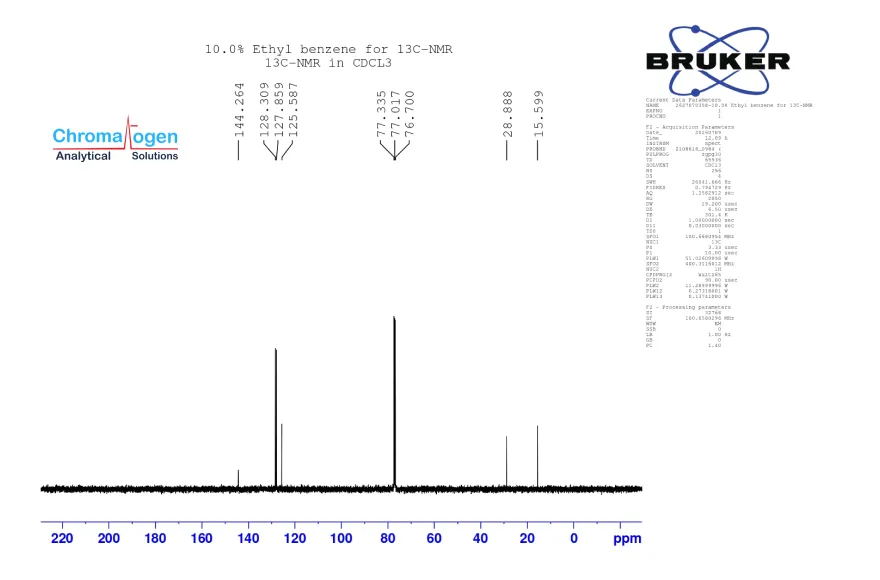
- Wide Chemical Shift Range: While 1H NMR spectra typically span about 0 to 12 ppm, 13C NMR spectra cover a much broader range (roughly 0 to 220 ppm). This expanded window drastically reduces signal overlap, making it easier to distinguish between different carbon environments (e.g., carbonyls, aromatic rings, alkenes, and alkanes).
- Differentiation of Functional Groups: Carbon atoms attached to electronegative atoms, double bonds, or triple bonds occupy distinctly separated regions of the spectrum, allowing for rapid identification of key functional groups.
Understanding DEPT and Advanced 13C Techniques
In standard broadband-decoupled 13C NMR spectra, all signals appear as sharp single peaks, removing direct clues about how many hydrogens are attached to each carbon. To overcome this, analytical labs utilize advanced pulse sequences like DEPT (Distortionless Enhancement by Polarization Transfer):
- DEPT-45: Shows all carbon atoms bearing at least one hydrogen (CH, CH2, CH3).
- DEPT-90: Displays only methine (CH) carbons.
- DEPT-135: Displays methyl (CH3) and methine (CH) carbons as positive peaks, and methylene (CH2) carbons as negative peaks.
Using DEPT alongside standard 13C NMR allows chemists to completely assign the carbon skeleton without ambiguity.
Core Applications
- Complex Molecule Verification: Confirming the total synthesis of natural products, synthetic drugs, and specialty chemicals.
- Polymer & Material Science: Analyzing polymer backbones, branching ratios, and co-polymer compositions.
- Impurity Identification: Detecting structural isomers or trace byproducts that share similar molecular weights but distinct carbon frameworks.
Elevate Your Research with Chromatogen’s Analytical Services
Accurate carbon skeleton mapping requires high-field NMR spectrometers, optimized acquisition parameters, and seasoned analytical expertise to interpret complex shifts.
At Chromatogen, we combine state-of-the-art analytical infrastructure with deep technical know-how to deliver precise, reliable spectroscopic data for your R&D and quality control needs.
Ready to accelerate your project with professional testing services? Contact Chromatogen today to speak with our analytical experts.