
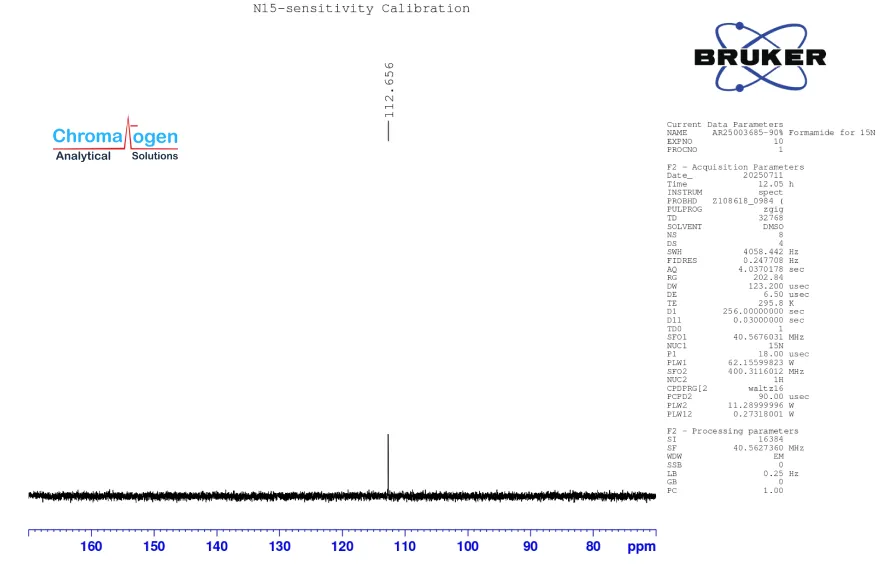
Nitrogen is a foundational element in organic chemistry, pharmaceuticals, proteins, and advanced materials. From amines and amides to complex heterocycles and nucleic acid bases, tracking nitrogen atoms is vital for complete molecular characterization. However, analyzing nitrogen is notoriously challenging. Enter 15N NMR (Nitrogen-15 Nuclear Magnetic Resonance) spectroscopy, a specialized analytical technique used to peer directly into the nitrogen framework of complex molecules.
While more complex to acquire than proton or carbon NMR, 15N NMR provides indispensable structural insights for advanced chemical research and drug discovery.
What is 15N NMR Spectroscopy?
15N NMR spectroscopy focuses on the nitrogen-15 isotope. Unlike the much more abundant 14N isotope (which possesses an integer spin and suffers from rapid quadrupole relaxation that causes severely broadened, uninterpretable peaks), the 15N isotope has a nuclear spin of I = 1/2.
This spin-1/2 characteristic allows 15N to yield sharp, well-defined spectral signals. However, it comes with a major hurdle:
- Low Natural Abundance: The natural abundance of 15N is only about 0.37%.
- Low Gyromagnetic Ratio: Its magnetogyric ratio is relatively low, making its inherent sensitivity quite weak compared to 1H or 19F.
Because of these factors, direct 15N NMR acquisition often requires prolonged scan times, concentrated samples, or 15N-isotopic enrichment. To overcome this in modern laboratories, analysts frequently use indirect, highly sensitive 2D techniques like HSQC (Heteronuclear Single Quantum Coherence) and HMBC (Heteronuclear Multiple Bond Correlation), which transfer polarization from neighboring protons to the nitrogen nuclei.
Key Applications of 15N NMR Analysis
- Pharmaceutical R&D & Heterocyclic Chemistry:Confirming the exact bonding, protonation states, and tautomeric forms of nitrogen-rich rings (such as pyridines, pyrimidines, imidazoles, and indoles) common in drug molecules.
- Structural Biology & Protein NMR:Essential for multi-dimensional protein NMR (such as TROSY and HSQC experiments on 15N-labeled proteins) used to determine 3D protein structures, folding dynamics, and ligand-binding interactions.
- Natural Products & Alkaloids:Elucidating complex nitrogen-containing natural compounds where standard 1H and 13C spectra leave ambiguity regarding bridgehead or amide positions.
- Materials Science & Polymers:Analyzing polyurethanes, polyamides (nylons), and nitrogen-based functionalized surfaces.
Advantages in Laboratory Workflow
Despite the acquisition challenges, the 15N chemical shift range spans over 900 ppm. This massive dispersion window means that distinct nitrogen environments, such as nitro groups, primary amines, secondary amines, amides, and nitriles, appear in completely separate regions of the spectrum. This eliminates signal crowding and provides unambiguous identification of functional groups.
Precision Analytical Solutions with Chromatogen
Tackling low-abundance nuclei like 15N requires high-field NMR instrumentation, optimized pulse programs, and rigorous analytical expertise.
At Chromatogen, our advanced analytical testing laboratory is equipped to help researchers decode complex molecular structures with confidence.
Ready to gain deeper insights into your chemical compounds? Contact Chromatogen today to discuss your NMR testing requirements with our experts.